Climate change is coming for your air conditioner
Read together, a Met Service bulletin and a global forecast, explain why heat is the Maldives' most immediate climate problem.

Ahmed Shabin (Guest Contributor)
3 mins
In its latest El Niño update, the Maldives Meteorological Service sets out what a strengthening Pacific event means for this country. Sea surface temperature anomalies in the eastern equatorial Pacific are above 2.0C, and the US Climate Prediction Center expects further strengthening through the end of 2026.
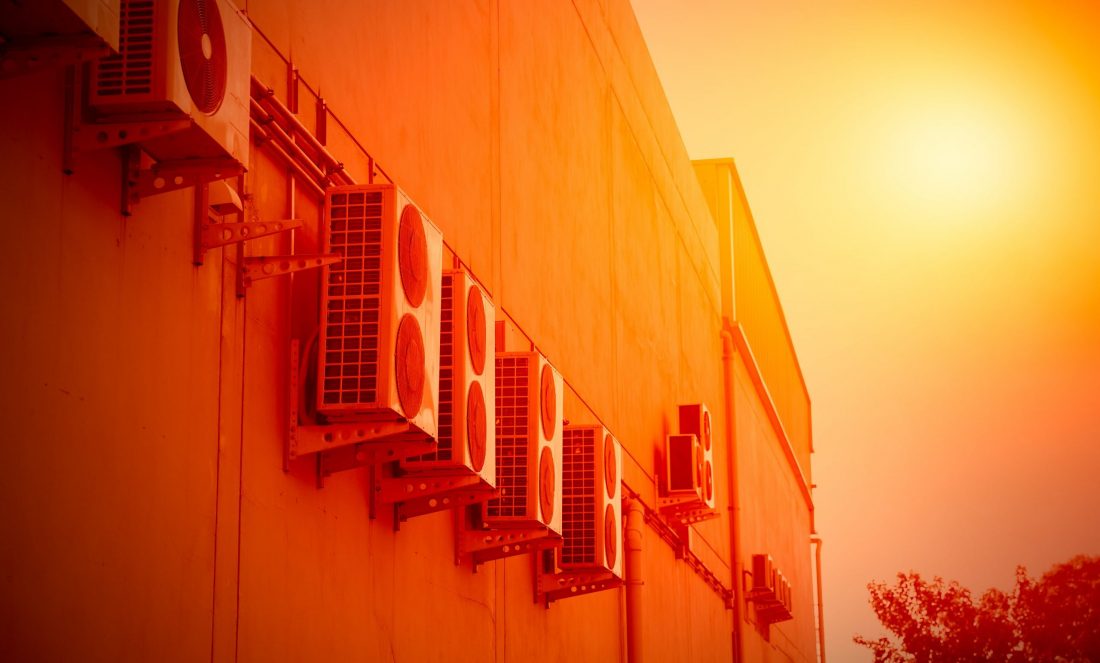
A first of its kind bulletin lists five sectors at risk: coral reefs, fisheries, tourism, agriculture and energy. Four of those we have heard about for years. Under energy, the service records that rising temperatures during El Niño years increase cooling demand, driving up consumption and straining power systems. That line describes how most people here will actually meet climatechange. Not just at the reef or the shoreline, but at the wall socket.

Figure 1: Projections of how hot 2026 and 2027 are tracking to be
An El Niño releases stored ocean heat into the atmosphere, and global temperatures follow a few months behind. Climate scientist Zeke Hausfather's latest projection, circulated this week by the Climate Council, puts 2027 at around 1.76°C above pre-industrial levels, with roughly a 95 percent chance of a record (Fig. 1). The current record, 2024, sits at 1.53°C. The striking part is the size of the step. It lands about 0.29°C above where the trend of the past ten years would have put it, meaning 2027 may briefly hand us temperatures the world was not otherwise expected to reach until the late 2030s.
Which brings up a line that circulates every time the heat makes the news: this is the coolest summer of the rest of your life.
The line has serious backing. In July 2022, launching the United States government's heat website, then Commerce Secretary Gina Raimondo said that summer was likely to be "one of the coolest summers of the rest of our lives". A year later, during record global heat, Peter Kalmus, then a NASA climate scientist stated that "this will be the coolest summer for the rest of your life". Patrick Galey of Global Witness reached for it again this June, after a European heatwave linked in one early study to more than 20,000 deaths.
Where the saying breaks down,
Taken word for word, it is wrong, and the El Niño now arriving shows why. El Niño and its cooler twin La Niña swing the whole planet warmer or cooler for a year or two at a time. Smaller, but also relevant, oscillations such as Indian Ocean Dipole, and ash cover from Volcanic eruptions do the same on a smaller scale. So a La Niña year can come in cooler than the El Niño year before it, even while the long climb continues. If 2027 lands where Hausfather expects, the years after will feel like relief. They will not be cool, only less extreme than the spike.
Where it holds up
What the saying gets right is the direction. On 2 September, the UN Environment Programme published its first report devoted to this question, and the finding was blunt: passing 1.5°C of warming is now unavoidable, and it will happen within a few years. Even on the most optimistic and hopeful path,warming peaks near 1.8°C around mid century (ie, 2050) before coming back down. On today's policies, the report puts the world near 2.6°C by 2100 (ie, in 73 years – one human life span).
So the temperature we will live inside for the next several decades is largely fixed. Cutting emissions still matters enormously for how bad things get later. But adapting to heat is no longer the second item on the agenda.
Heat arrives before the sea does
The Maldives has argued the case on sea level rise for thirty years, and rightly. Yet sea level rise is slow. It shows up as a harbour wall design or a reclamation decision. Heat shows up tomorrow.
Our average temperature is about 28°C all year, with no cool season to fall back on, and in Malé average maximum temperatures have been climbing by roughly 0.17°C per decade. Because humidity sits near 80 percent, the strain on the body is worse than the thermometer suggests, and nights are warming faster than days, which decides whether a person recovers before morning. On 4 April this year, the feels like temperature in Malé hit 37.3°C. Construction workers, fishermen and drivers take that directly, as do families in crowded rooms.
Classrooms are being dealt with. The ‘Cool School’ project is fitting air conditioners in all 3,704 government classrooms, and at the launch the education minister said state spending would rise by 38 percent once the units are running, with a fifth of it to be met from renewable energy. That is a fair picture of the trade the whole country now faces: relief indoors, bought with more electricity.
The nights are the harder half
Most attention goes to the midday peak, but the night is doing more damage. The body sheds the day's heat while you sleep, and it needs the air around it to be cooler to manage that. Across the tropics, night time lows are rising faster than daytime highs, and in Malé the temperature now rarely falls much below 26°C after dark. With the humidity, it feels warmer than that. A hot night means broken sleep, and weeks of broken sleep show up as fatigue, poor concentration and worse health, especially for older people and anyone already unwell.
This is how cooling has quietly shifted from a comfort to a necessity. Households with an air conditioner increasingly run it all night, often with a fan going as well because one alone no longer settles the room. Longer hours mean higher bills and more breakdowns, and a unit that fails in April is not a small problem. Households without one simply lose the sleep.
A simple way to measure it: cooling degree days
Engineers and power utilities use a measure called cooling degree days. Each day, you count how many degrees the average temperature sits above a comfortable level, usually 20°C, and add those up over the year. A day averaging 29°C scores 9 (29 – 20). A year of such days scores 3285 (365 x 9). Allow me to emphasize that here we are considering average temperature of the day.
That one number shows why our problem is different from a cold country's. Researchers treat 3,000 as the mark of extreme cooling conditions. We are past it, all year, with no break.
Two things follow. In colder countries, warming cuts the heating bill as it raises the cooling bill, so the two partly cancel out. Here there is nothing to cancel. Everything is added. And the maths is simple: another 1°C adds about 365 cooling degree days, close to a tenth more work for every building, generator and cable in the country. Analysis of station data from Maldives Meteorological Service reported an increase in cooling degree days index was clearly stated in the Biennial Transparency Report submitted to UNFCCC by the Maldives in 2024, linking higher temperatures and increased energy demand for cooling systems. It is worth noting, standard cooling degree days factor in temperature alone; incorporating extreme tropical humidity via Enthalpy Degree Days shows the actual load on cooling infrastructure to be even more severe.
The demand is already visible. STELCO's figures for April show electricity use rising with the heat through the day, from about 96 megawatts in mid morning to 121 in the evening, and the utility links the March to May jump in household bills to air conditioners working harder. In a country running on imported diesel, that means more fuel bought in foreign currency, higher subsidies and higher emissions.
It is also a fairness problem. Where cooling is unaffordable or the grid is small, as on many outer islands, more heat becomes a health burden rather than a bigger bill.
What to do about it
Treating heat as an energy and health issue is essential.
Building rules do the most. Shade, orientation, ventilation, roof colour and insulation decide how much cooling a building needs before anyone switches anything on, and fixing that later costs far more. Efficiency standards matter almost as much, because cheap units lock households into high bills and the grid into high peaks.
Here the framework already exists. The Hakathari programme, launched by the environment ministry in September 2021, is the country's energy efficiency standards and labelling scheme. It sets minimum performance requirements and puts a one to five star label on air conditioners, refrigerators and washing machines, so a buyer can see at the point of sale roughly what a unit will cost to run rather than only what it costs to buy. Approved models are listed publicly, and the air conditioner category covers the single split units most homes use.
The limitation is that it remains voluntary. Importers opt in, register each model and affix the label, and nothing yet prevents an unrated unit clearing customs. The programme document anticipates a mandatory phase, with customs checks at that point. Given the degree day arithmetic, the argument for getting there sooner is largely about how many inefficient units are sold in the meantime, each of them running through the night for a decade.
Greenery does similar work outdoors for less. Trees, shaded walkways and planted courtyards lower surface temperatures and take the edge off the heat that concrete and asphalt hold into the night. Land is scarce, but roofs, road edges and school grounds are barely used.
The cheapest measure is information, and there is a gap here. The Meteorological Service publishes observed feels like temperatures three times a day, which tells us what is happening now. What we lack is a heat advisory: a forward looking alert, issued a day or more ahead, warning that conditions are due to become concerning. Humidity is why it must be built on how the air feels. Sweat evaporates poorly here, so the body struggles at readings that look unremarkable, and an alert keyed to air temperature alone would stay silent on the worst days.
An advisory is only worth issuing if sectors act on it. The legal scaffolding already exists. The Employment Act requires employers to provide safe systems of work, protective equipment and safe conditions at no cost to the worker, along with minimum standards for site accommodation and basic amenities such as potable water and shelter. The Occupational Safety and Health Act of 2024 and the regulation under it, No. 2024/R-103, in force since that October, added the machinery: every employer must adopt and enforce a health and safety policy meeting minimum standards set by the Labour Relations Authority. What an advisory would add is a trigger, a day on which those policies shift to hot weather arrangements rather than each employer judging the afternoon alone. Enforcement, and the wider health and safety of outdoor workers, many of them migrants, remains the harder part. Schools have shown what acting on a forecast looks like. Following the Met Service outlook for April this year, students were allowed to wear the lighter activity uniform in place of the standard one. A small change, made on a seasonal forecast, and worth repeating every year as a matter of course.
Then there is the power itself. Cooling demand climbs with the sun, which makes solar the obvious lever, and the country has committed to drawing a third of its electricity from renewables by 2028. Most of the visible push has been large scale, and as of mid 2024 solar supplied around six percent of electricity consumed. Household uptake is thinner, though not for want of a scheme. Magey Solar, launched by the Environment ministry and funded by the Asian Development Bank, offers a 3 kW system for MVR 45,000 or 5 kW for MVR 75,000, payable in one go or over five years, which works out at MVR 750 a month for the smaller system. The ministry's own road map names public awareness of that arithmetic as a gap to be closed.
The binding constraint, though, is not the panel but the wire. Asked in parliament why households on Kanditheemu had been refused permission to install rooftop systems, then environment minister Thoriq Ibrahim explained that the island's network could take no more than 40 percent additional connections without putting its stability at risk, and that solar there was already meeting 43 percent of peak load. Anything further needs battery storage and network upgrades first. The ceiling on household solar is set by the strength of the local grid, not by the appetite for it, which makes unglamorous network investment the precondition for everything else.
Individual annual temperatures will jump around, and the ones after 2027 may well feel like a reprieve. The floor underneath them keeps rising, and +1.5°C is now behind us in all but name. What that means here is not a distant shoreline problem. It is a longer running compressor, a higher bill at the end of the month, a night that never cools enough to sleep through, a shift that has to start earlier to stay safe. Climate change is coming for your air conditioner. The question is whether we meet it with better buildings, more shade, warnings that arrive before the heat does, and swapping fuel takers to harnessing the power of the sun, or simply with a bigger aircon unit and a bigger diesel bill.