The resilience that was already there
A reflection on food systems, resilience, and islandness in the Maldives.

Anaa Hassan
5 mins
There is a story about small island states that gets told so often it has stopped sounding like a claim and started sounding like a fact. The islands are small. They are remote. They import almost everything. Ninety per cent of food in the Maldives arrives by ship. Eighty per cent of our islands sit less than a metre above the sea. From these numbers a conclusion is drawn — that we are fragile, dependent, waiting for the next shock to arrive and for someone else to help us survive it.
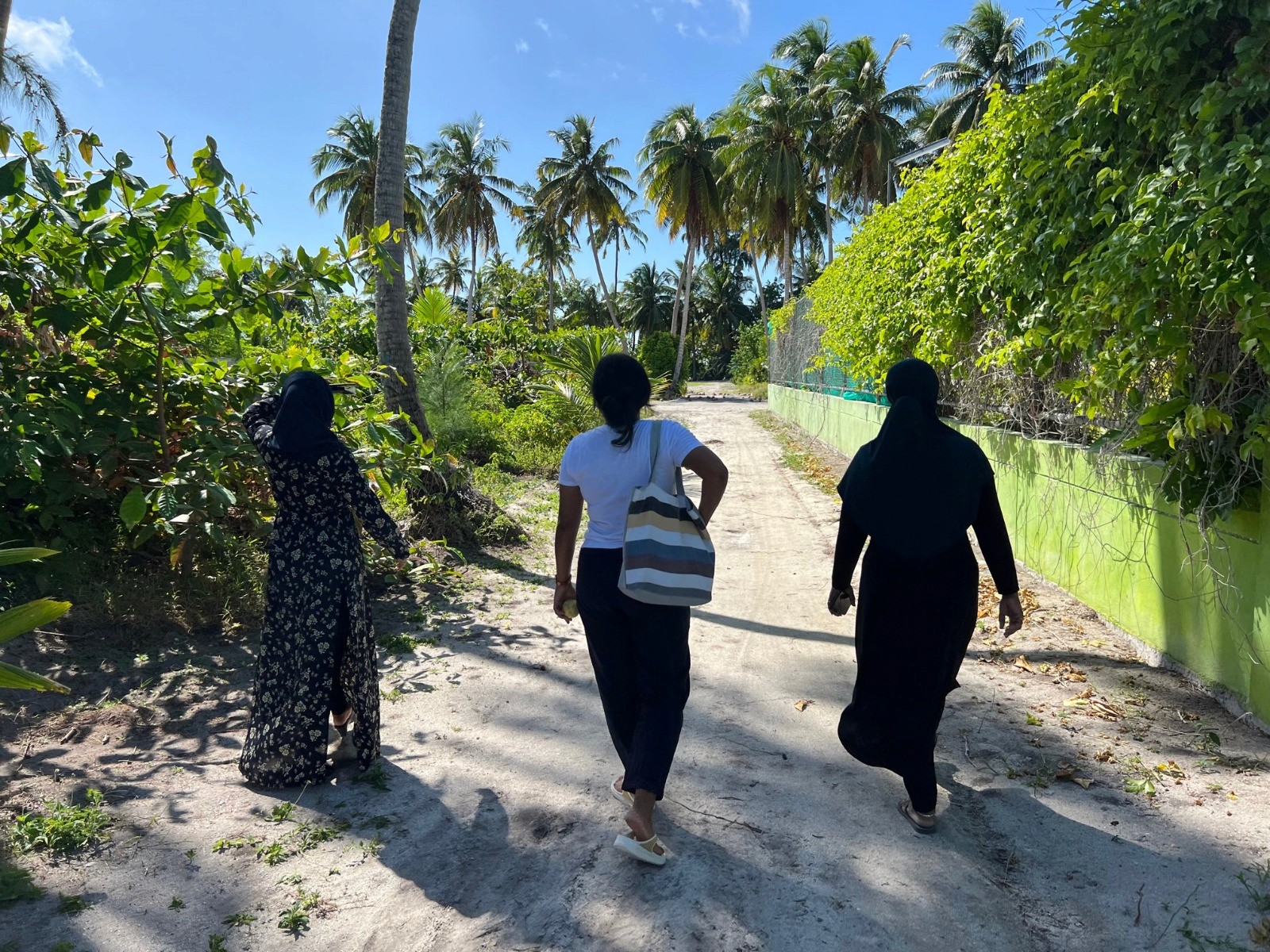
I spent nine months, between October 2021 and July 2022, testing that conclusion against what people actually do. The research took me to Felidhoo in Vaavu Atoll, 679 residents, seventy-eight kilometresfrom Malé, and to Magoodhoo in Faafu Atoll, 922 residents and twice as far. It involved 139 conversations — with fisherfolk and farmers, council members, shopkeepers, supply boat crews, health officers, guesthouse owners, food importers, and officials in Malé. Interviews in Dhivehi, and long walks with people around their islands, watching what they did with food rather than only listening to what they said about it.
The COVID-19 pandemic should have broken these food systems. Supply chains failed globally. Movement stopped. And yet the islands did not go hungry.
What I found was not an absence of vulnerability. It was the presence of something that vulnerability frameworks are poorly equipped to see.
The first is what people do without being asked. Food sharing in the Maldives is not an emergency measure that switches on when a crisis begins. It is the ordinary texture of island life — the containers that travel between houses during Ramadan and come back full of something else, the surplus from a kitchen garden that goes to a neighbour. When the pandemic arrived, this did not have to be invented. A farmer in Magoodhoo told me she had a glut of watermelons and gave them away rather than sell them, to relatives on the island and to relatives in Malé, because people were suffering. Councils on one island loaded supplies into boats from neighbouring islands that waited out in the lagoon. This is agency, exercised through habit.
The second is connection, not isolation. Islanders are not cut off. A woman in Magoodhoo sends her weekly shopping list to her sister in Malé by message, the sister buys it cheaper, and it comes on the ferry that runs three times a week. A shopkeeper in Felidhoo restocks on credit from a friend who owns a wholesale company, because they trust each other. Scale up and the same pattern holds: an importer who has bought from the same Indian firm since 1989 and describes the relationship as family; a trade agreement dating to 1981 that lets the State Trading Organisation bring in key supplieswhen the Ramadan price spikes. The sea has never been a wall. It is a road.
The third is that smallness can be an advantage in governing. Maldivian island councils have real, defined jurisdiction. During lockdown, the council in Magoodhoo collected shopping lists from every household, chartered a private vessel to Malé, and distributed what it brought back. Felidhoo's council took pre-orders when fishing boats came to trade, bought the fish, and let households repay later. A small population is not only a constraint on markets. It is also a unit small enough to be known, monitored, and coordinated quickly.
I want to be careful here, because the argument is easy to misuse.
Demonstrating resilience is not the same as declaring that everything is fine. Food costs are higher the further you live from Malé, and arrives in worse condition, because storage and transport are inadequate. The cheap processed food filling that gap is driving a health burden that a food-availability lens does not register. A shopkeeper told me people would not buy from him because they had closer ties to the shop across the island — social capital includes some people by excluding others. Price volatility, geopolitical friction, a war in Europe, and climate change all sit on top of these systems. Resilience is not a substitute for investment. It is what has kept people fed despite the absence of it.
What follows from this is a different starting question. Not what do these islands lack? but what already works here, and what would it take to strengthen it? The first question produces interventions that arrive from outside and leave when the funding does. The second produces something that was already load-bearing before anyone showed up to help.
Islands are not waiting to be rescued. They are already doing the work.